
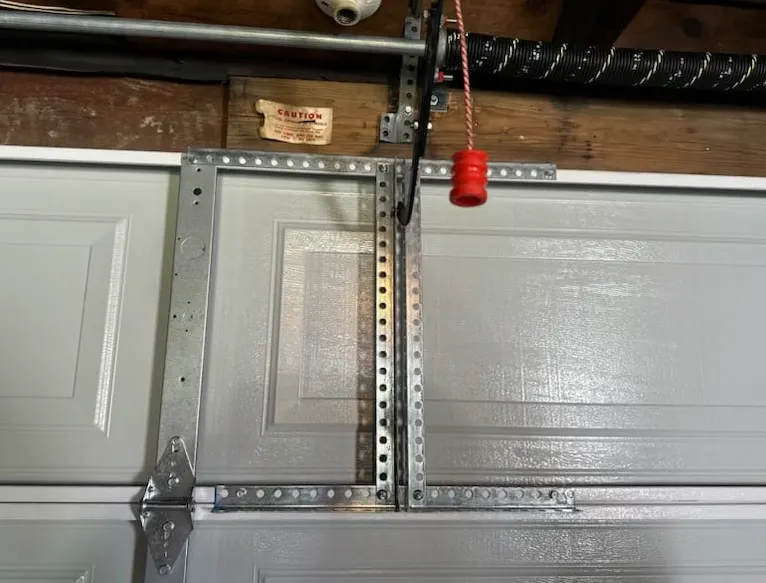
The Rule of Thumb
Pull the emergency release cord only when the door is fully closed, the opener has no power, and you need to move the door by hand. That's the whole safe-use case in one sentence. Everything else is an exception, and most garage door injuries and busted panels happen when someone pulls the cord outside of that narrow situation.
What the Cord Is Actually For
The red handle hanging from your opener's trolley disconnects the door from the motor. It exists so that if the power goes out, or the opener itself fails, you can still open the door manually to get a car out or get into the garage. In Marion County, that's not a hypothetical. Hurricane-season outages are common, and when the power drops mid-storm with the door closed, the release cord is often the only way in or out of the garage until service is restored.
Once pulled, the door is no longer connected to the opener's chain or belt. It runs purely on its spring tension and whatever force you apply by hand. That's the part people forget.
What Goes Wrong, and How Badly
The release cord is simple, but misusing it exposes the one part of the system that can genuinely hurt someone: the springs.
- Pulling it while the door is open or halfway up. With no opener holding the door and a spring that isn't doing its job (weak, broken, or stretched from humidity and age), the door can drop fast. A door coming down uncontrolled can injure hands, feet, or anything underneath it, and it can also slam hard enough to crack a panel or bend track.
- Pulling it when a spring is already broken. If a torsion or extension spring has snapped, the door has lost its counterbalance. Disconnecting the opener removes the last thing holding the door up. It can fall freely, and manually lifting it afterward becomes a two-person job at best, or a trip to the ER at worst.
- Pulling it and then forcing the door along rusted or swollen track. Salt air and humid swings in this part of Florida cause rollers to corrode and wood jambs to swell. A door that's already dragging on its track can jump off entirely once it's running on manual effort instead of smooth motor power, which turns a minor off-track issue into a door that's now wedged or tilted in the opening.
- Leaving the cord disconnected and forgetting about it. After a storm, some homeowners reconnect the opener days later without checking the travel limits or auto-reverse. A door that was left manually disconnected can reconnect misaligned, closing too hard or not reversing properly if something's in the way.
None of this means the cord is dangerous to use. It means it's meant for one job, and asking it to do more than that is where things go sideways.
Actions That Prevent the Problems
- Only disconnect with the door fully down. If you need manual access during an outage, close the door first if it's safe to do so, then pull the cord. Lifting a disconnected door from the closed position is far more predictable than catching one that's already in motion.
- Test the balance before you rely on manual lifting. With the opener disconnected, a properly balanced door should lift with one hand and stay roughly where you leave it, around waist height. If it crashes down or shoots up, the springs are off and you shouldn't be operating that door by hand repeatedly until they're adjusted.
- Don't force it on the track. If the door feels gritty, grinds, or hangs up partway, stop. Forcing a manually operated door past a rough spot on corroded track is how doors jump the rail.
- Reconnect correctly after an outage. Pull the trolley back until it clicks into the opener carriage, then run the door through a full open-close cycle while watching the travel and the auto-reverse response before you trust it with a car in the way.
- Keep the cord accessible and don't shorten it to keep it out of a child's reach. Loop it up instead. A cord that's been cut short or tied off is hard to grab fast when you actually need it, and that defeats the point of having one.
- Seasonal check before storm season each year. Since the release cord's safety depends on the springs behind it, a yearly look at spring condition and roller wear matters more here than in drier climates, given how much humidity and salt air accelerate corrosion on hardware.
When to Call Anthony Garage Door Repair
If your door drops fast, won't stay balanced, or grinds on the track when disconnected, that's not a manual-operation problem, it's a spring or track problem, and it's worth having it looked at before the next outage forces you to use the cord again. Anthony Garage Door Repair handles garage door spring repair and garage door tune-up and maintenance, including checking balance, roller condition, and track alignment so the emergency release actually works the way it's supposed to when you need it. We also reset and realign openers after a manual disconnect if the door isn't tracking or reversing correctly once reconnected.
If you're in Anthony, Ocala, Silver Springs, Citra, Reddick, Sparr, Orange Lake, or McIntosh and your door doesn't lift smoothly by hand, or you're not sure your springs would hold if the power went out tonight, give us a call. We'll check it before storm season decides to test it for you.